Estimated reading time: 17 minutes.
It was time! Time for me to get back to Africa after a period of abstinence lasting quite a few years. But this time not to the South but to the East: I traveled to Kenya! Of course for some safari but also to see Nairobi, Mombasa, Nakuru, Naivasha… An unbelievable 3-week adventure that not only took me to the foot of Kilimanjaro, but also on a ride with a Matatu and got me stuck in the middle of the Maasai Mara. This post will focus on the safari elements of the trip. I tried to write a full blogpost about the whole trip, but it just became longer and longer. So here is the safari focused version.
The safari parts of the trip were planned in two sections, always with a few days between them – which turned out to be a very good idea when I got stuck in the Maasai Mara. Basically I booked the flight to Nairobi and the accommodations in between the different safari sections. But the safaris were planned by local agencies – which I can highly recommend because there are a lot of different parks and routes and places to go. To get from Nairobi to Mombasa and back, I decided to take the Madaraka Express, which is said to be the only “high speed” train on the continent and also sometimes is referred to as the “safari train”. But before you get your hopes up: Even though the train passes through a couple of national parks, you will not see a lot of animals. But lets begin at the beginning…

After a short stop-over in Kairo, I arrived in Nairobi very early in the morning. I did buy an eSim online beforehand (via Holafly) because I wasn’t sure if the stores for (e)sims at the airport would be open so early in the morning. They were. But I was able to avoid the hordes of drivers waiting at the airport and could book a ride via the uber app while still inside of the airport. Highly recommended – you just have to select “Pay Cash” in the app because at least Apple Pay is not working in Kenya. Off to the hotel in “Uptown” – the Sarova Stanley – through Nairobi just before sunrise. I was too tired to appreciate the empty streets of the city. The hotel was brilliant, very nice and helpful staff, and is quite a historic site: It was opened in 1902 and did not only house princess Elisabeth in 1952, but was also home to the “Nairobi Stock Exchange” for a few years. Today the “Exchange Bar” of the hotel is a reminder of those trading days. And while talking about the bar, the hotel was the first place to sell Kenya’s Tusker Beer in 1922. The legend says that the first ten bottles were hand-produced and personally delivered to the hotel’s manager. And you can still get it at the bar today. After 3 nights in Nairobi, on day three the safari operator collected me at the hotel to drive to Amboseli National Park. The only safari-related activity in Nairobi was a visit to the Nairobi National Park – or, more precisely, the safari walk at the park. No need to enter the park with a car when you have 10 days of guided safari tours ahead of you. But I can highly recommend the safari walk where you can get pretty close to many of the animals – I petted a giraffe!

After this cautious introduction to safaris, I did see more of the city, booked a guided walking tour, learned the difference between “Uptown” and “Downtown” and I was able to actually ride a Matatu – privately owned minibuses used as public transport. What. An. Experience. These minibuses turn into flashing disco-transports at night and are usually decorated with portraits of famous people or slogans/sayings. Very colourful and often hand-painted. And loud – did I mention that? Usually multiple TVs will underline the music with according music videos. Nobody will complain about noisy passengers for sure.
From Nairobi to Amboseli
The safari literally starts at the hotel: The guide picked me up with his Toyota Land Cruiser 4×4. My first thought was: This thing looks like a tank – you can get through any terrain with that. Well, we will see about that. But the first destination – the first park of the safari – was the Amboseli National Park. This also implied a ~250km drive through the country on the highways – with the Land Cruiser and me in the back. All the tour operators have locations along their routes where they stop for a break. Usually with the possibility to eat/drink something, find a toilet and of course buy some souvenirs. But a welcome break for sure since not only the traffic on the highways is intense. Overtaking and “Load securing” play in a very different league compared to Europe. This meant a number of interesting encounters along the way. From busses doubling their height with the luggage on the roof to people transporting multiple sofas on a single moped! But I arrived at Amboseli around noon, which meant there was time for an evening drive into the park before dinner.

And then there was of course the “side attraction”: Mount Kilimanjaro! It is not only the highes mountain in Africa, it is also the highest free-standing mountain above sea level in the world at 5,895 m. When I arrived it was still hiding behind the clouds – you can see a shot above taken the next morning from the camp. But before coming to Kenya I was joking that all I wanted was some kind of “wild animal” in front of Kilimanjaro during sunset with a clear view of the mountain in the background. And the shot below was literally on my first day of safari. Wow.

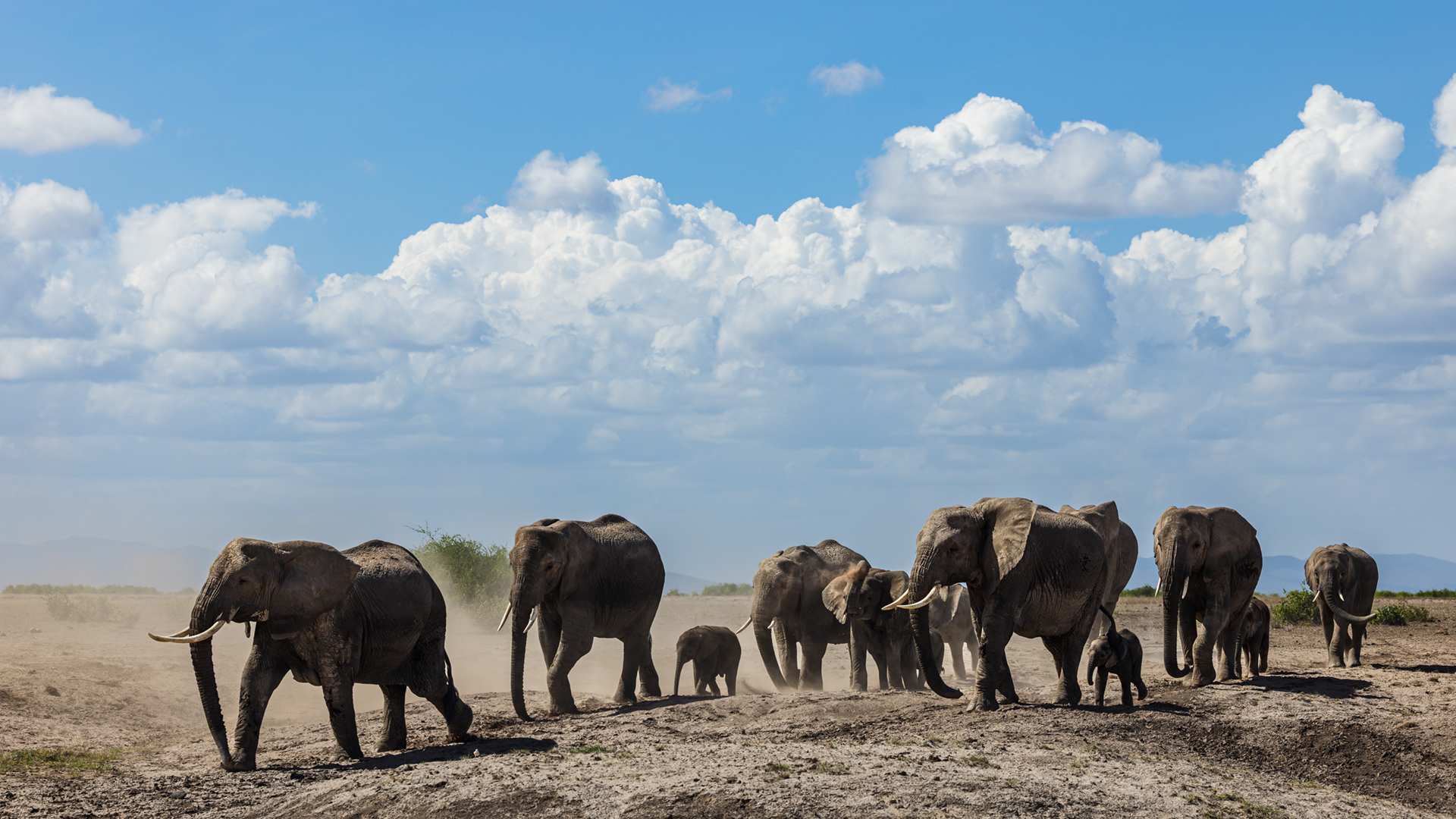
But I am getting ahead of myself. First there where elephants, giraffes, hippos, gazelles, monkeys, zebras, … Well, you get the idea. Patrick, my guide, said that Kenya (and Tanzania) are the places where people from Africa go for safari. I can understand why. The sheer number of animals you see is incredible. The only thing for me that comes close to this experience was a trip to the Etosha in Namibia many years ago. But Kenya was an incredible experience – maybe especially for photographers. The Amoboseli National Park is also known for a group of elephants – or “super tuskers” – that frequently can be found there. And as you may have guessed from the description, they are famous for their very long tusks. And one of them more or less greeted me also on the first day, maybe to welcome me to Amboseli. I have seen wild elephants before but this was very special. You can see my favourite shot below – a Grey Eminence indeed. Unfortunately I also learned later on my trip that one of the last super tuskers called “Craig” died at the age of 54. This made the news not only in Kenya but around the world.

But there was so much more to see at Amboseli! I want to invite you to check out the gallery down below on flickr. I feel I can not describe all the little encounters and situations inside the park here. But there is one other place inside Amboseli that I want to point out: The abandoned Amboseli Lodge that was once among the most established safari lodges in the area. In the early 2000s the lodge suffered a major setback when it was severely damaged by heavy flooding. This rendered parts of the property uninhabitable and ultimately lead to the complete abandonment of the lodge. The only residents now are baboons, who have taken over the ruins and allow for some interesting shots.

I only had 2 days in Amboseli but they felt a lot longer. Next destination was Naivasha, which also meant driving past Nairobi to the Osotua Lodge. You can see the details of the route on the map below.
From Amboseli to Naivasha
The trip across the country by car was very interesting – again. But my guide was a very good driver and I felt very safe on the roads. But overtaking on the roads of Kenya takes some – well, I guess experience. But for me it felt a bit more like death-defying courage. But I arrived in one piece. Naivasha means less of a safari with game drives, but rather two main attractions: A bicycle ride through the Hell’s Gate National Park – yes, on a bicycle – and of course a boat ride on the lake Naivasha itself.

The boat ride is a special experience: You will get close to hippos in the water. Mother hippos with babies. So you don’t want to get to close and you certainly don’t want to be stuck next to them. And you will also see a lot of green vegetation close to the shore of the lake that will get you stuck. So, just relax and enjoy the boat ride. There are pelicans and eagles to make up for the hippo-stress. But the situation is actually quite dramatic: The water level of the lake has risen due to climate change in the last couple of years. Making the vegetation problem at the shores more imminent. The first couple of meters into the lake with the boat was along former houses and looked quite apocalyptic. And the levels keep rising. I had a safari walk on foot at a small park next to the lake where I met zebras and buffalos and stepped onto the “roof” of a hyena den. With the hyenas still inside.

On the way back by boat I could already see some dramatic clouds. A thunderstorm was getting closer. But I made it in time to the shore and had a good night sleep before the next adventure: Hell’s Gate National Park. The wildlife of Hell’s Gate National park includes vultures, but also gazelles, zebras, buffalos – and, well, occasionally lions, leopards and cheetahs. And me. On a bicycle. It’s difficult to describe the feeling riding along the Hells Gate gorge on a used child-size mountain bike (see image below), but it does allow for a great view of the red cliffs of the gorge and the Fischer’s Tower, which named after the German explorer who reached the gorge in 1882. And I didn’t see any lions there. But at the end of the road through the main gorge waits a smaller gorge which extends to the south. Not only was this smaller gorge the main inspiration for the setting of the animated film “The Lion King”, but also the movie “Tomb Raider – The Cradle of Life” was shot on location in this park. The walk through this gorge also includes hot springs with sulfuric water and maybe a guide singing the Lion King theme on the way. Who knows.

At the end I was happy to get off the bike and into the Land Cruiser. And luckily lake Nakuru is only a 2.5h drive away from Naivasha. With almost no overtaking happening.
From Naivasha to Nakuru
After arriving at the Ziwa Lodge, there was some time for relaxing. The dinner at the main building featured a nice and cozy fire place and later at night frogs at a small pond that sounded like beer glasses on the Oktoberfest. The lodge donates a portion of the proceeds to the East African Mission Orphanage, which I think is a great way to share the income from tourists with the local community. The next day included a game drive through the Lake Nakuru National Park, which happens to be on the way to the Maasai Mara. It is a small park right at the southern shore of the lake and it is mainly famous for birds and pelicans, but I also saw the first lion of the trip! A bit far away – sleeping – under a tree. But I was excited and retrospectively it may have been a good sign for what was about to happen in the Maasai Mara.

And even though the park is small, I did see the only rhinos of the whole trip. Also far away but you can see them on the photo above – more as a proof for myself than anything else. On the way to the accommodation in the Maasai Mara – the Ol Kinyei Tented Camp – I had the opportunity to visit a Maasai village. There are of course many villages for tourists, often right next to the highway, that more or less only consist of souvenir shops. You will see dozens, if not hundreds of tourists swarming there. So I was very happy to be able to visit a village a bit further away from the usual tracks. You can see the welcoming ceremony on the picture below with the village in the background. Since I was a little kid I always wanted to visit the Maasai. It may sound silly, but for me this was quite an experience. And I think I didn’t do too bad with the jumping myself – the evidence is under seal of course.

Into the Maasai Mara
On the way into the Maasai Mara it started to rain a little bit here and there, and after arriving – during dinner – the weather changed. A proper thunderstorm would test the watertightness of my tent: It was raining the whole night. To be honest: I wasn’t sure if it would be possible to drive in the park the next day. Even with a 4×4. But my guide explained that it is not uncommon to have rain like that and for spotting animals it is actually beneficial because it is not as hot and many animals come out after the rain. So I might even see some lions hunting. And I did. But you can see in the image below that even a proper 4×4 can get stuck in the Mara. But luckily help was there in minutes. As you may have guessed from the photo: I had to change the car. It was a 2-day endeavour to get the car out. But I could continue the safari. I have never seen so many people come for help so quickly and the organisation was very professional. I didn’t miss anything on the trip. But the car – and my guide – were the talk of the day.

After I switched the car I saw so many lions – including a live kill. The weather was bad for the drive but very good for the lions. I cannot share all the photos I shot and I would once again invite you to check out the album on flickr at the bottom of this post. But one shot stuck with me, because it shows the lions, the weather and the hunt. I think it is my favourite lion shot of the trip. You can see it below.

Tsavo East & West
The second part of the safari was Tsavo East & Tsavo West. This was later during the trip, I had already gone to Mombasa via train and was picked up there. You can find photos from the “non-safari” part also in the gallery on flickr at the bottom of this page. Tsavo is said to be one of the oldest and one of the biggest parks in Kenya, and one cal immediately feel the difference: The distances are bigger and it is more difficult to spot the animals. One of the distinct features of the park is actually the red soil. You will find references in many names, e.g. for bars or hotels. A frequent one that I didn’t really understand in the beginning was the reference to “red elephants”. In my mind, and from what I saw until then, they were grey eminences. But then I saw my first “red elephant” – as you can see on the picture below. Due to the red soil of the Tsavo National Park in Kenya the elephants are actually red. The bull in the picture below apparently had a dust bath not too long ago and with the green contrast these elephants almost look surreal.

As you can see on the image below: Even without any animals in the photo the landscape looks surreal and very contrasty. But the landscape changed once I got “into the other half” of the park – meaning Tsavo West.

My first association after coming to Tsavo West was: Welcome to the jungle! Very dense vegetation, hills and mist in the morning. There are no gorillas in Kenya, but if there were, they would probably like Tsavo West. I was fortunate enough to get a spot at the Ngulia Safari Lodge, which has founded in the 1950s and sometimes has very special visitors during dinner. On the panorama below you can see the view from the lodge. Very green and somewhere in there you can find the Ngulia Rhino Sanctuary. I did go, but unfortunately missed the rhinos there.

But that night, back at the lodge, another highlight was about to happen. Maybe just for reference: The lodge is open, no fences or anything. Which means that animals could in theory walk through the lobby of the lodge. There is a water hole right next to the lodge – and a fancy looking tree. This artificial tree is part of the absolute main attraction of the lodge, because some nights a leg of lamb is hung from the artificial tree. A ritual that has happened since the 1950s and is no less spectacular today: If you are lucky one of the leopards of the area will come along and get some lamb. Of course sometimes they just prefer to come late during the night, but I was lucky because I was just about to have dinner myself when a leopard showed up and went for the lamb. Maybe 15m away from my dinner – no fences in between. I was absolutely stocked to see this incredible animal so close. Nobody was worried (maybe except for me) that the leopard might change his dinner plans and have whatever was on my plate. But the situation was bizarre and fascinating and beautiful at the same time. The leg was gone in no time – and so was the visitor. You can see him “approaching” on the picture below and some more shots of him devouring that lamb can be found in the gallery on flickr. A dinner that will certainly stay in my memory forever.

How to summarise a safari experience like this? It was just stunning: The landscape, the people and I saw the big five in a single trip. Something that took me many visits to South Africa over many years before. Kenya is an incredible country, beautiful and relatively easy travelling for Africa. I want to come back again – for sure! I think the mixture of travelling, relaxing and safari was perfect for a first time visit. But next time I would probably spend the whole time on safari and would always stay multiple days in every national park. Please check out the gallery on flickr down below. And maybe there will be more Kenya posts in the future. Who knows.
Enjoy!
Useful Links
- Book safaris online via Safari Bookings
- Imara Africa Safaris
- More info on the abandoned Amboseli Lodge
- Madaraka Express Online
- Ngulia Safari Lodge


